
SPECIAL BERTIE POST
Why Hotels Need GEO Before They Disappear From AI Search

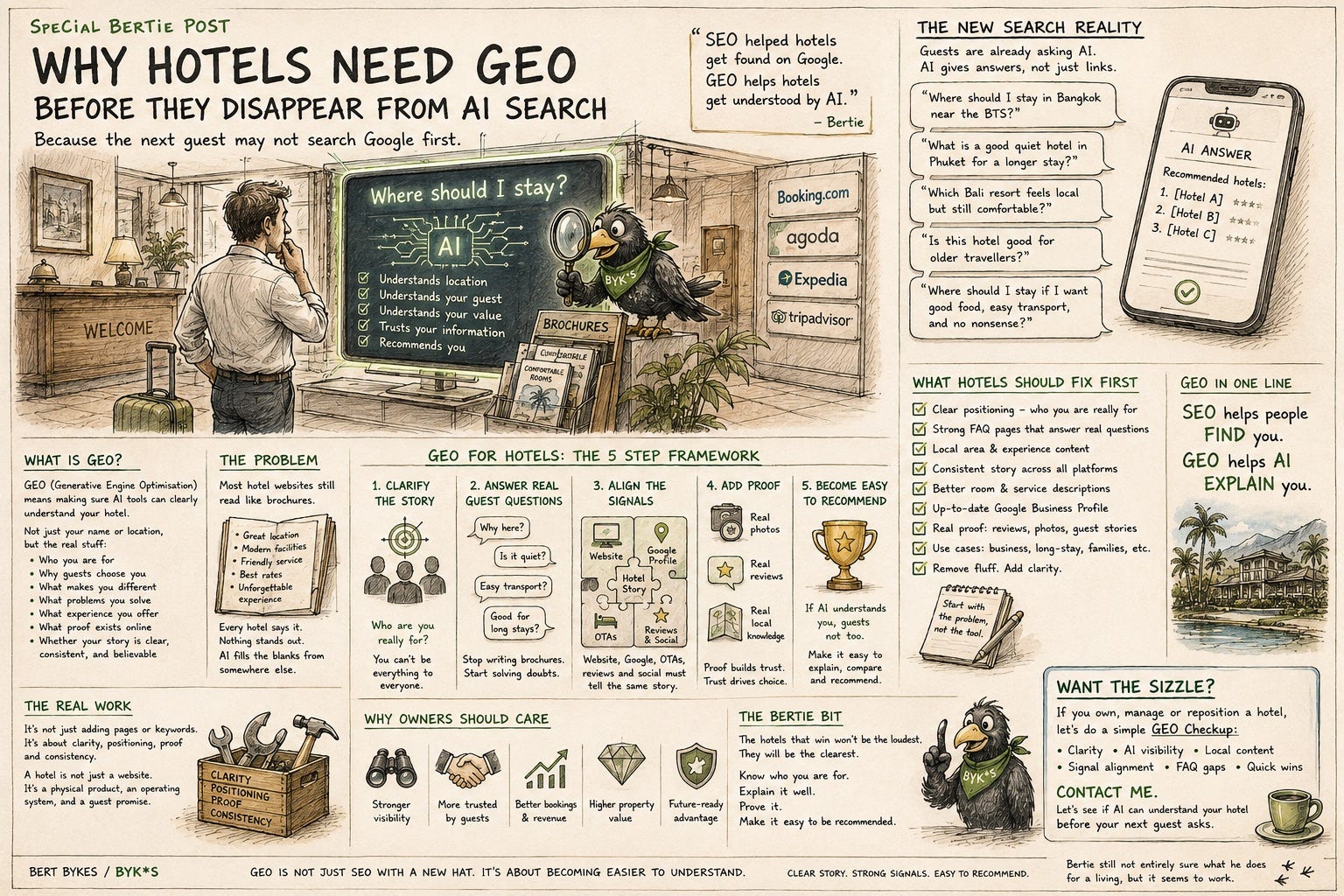
Because the next guest may not search Google first.
Hotels used to worry about Google.
Fair enough.
If you were not on page one, you were already halfway invisible.
Then came OTAs, social media, Google Maps, review sites, reels, influencers, and endless “best hotel near…” searches.
Now something else is happening.
Guests are starting to ask AI.
Not always.
Not everyone.
Not yet.
But enough to matter.
They ask things like:
“Where should I stay near public transport in the city?”
“What is a good quiet resort for a longer stay?”
“Which island resort feels local but still comfortable?”
“Is this hotel good for older travellers?”
“Where should I stay if I want good food, easy transport, and no nonsense?”
And here is the scary bit.
AI does not just show a list of links.
AI gives an answer.
That changes the game.
First, What Is GEO?
GEO stands for:
Generative Engine Optimization.
Sounds fancy.
It is not.
In simple words, GEO means making sure AI tools can clearly understand your hotel, resort, or property.
Not just your name.
Not just your location.
Not just your room rate.
But the real stuff:
who you are for
why guests choose you
what makes you different
what problems you solve
what experience you actually offer
what proof exists online
whether your story is clear, consistent, and believable
SEO helped hotels get found on Google.
GEO helps hotels get understood by AI.
That is the shift.
The Problem With Most Hotel Websites
Most hotel websites still read like polite brochures from 2007.
You know the words:
comfortable rooms
friendly staff
great location
modern facilities
unforgettable experience
best rate guarantee
Nothing wrong with those words.
But they are not enough anymore.
They do not tell AI much.
They also do not tell guests much.
Every hotel says it has a good location.
Every hotel says the rooms are comfortable.
Every hotel says the staff are friendly.
So what is the real reason someone should pick you?
That is where many hotels go quiet.
And when the hotel goes quiet, AI fills in the blanks from somewhere else.
That somewhere else may be:
old reviews
OTA descriptions
weak third-party listings
random travel blogs
outdated photos
inconsistent Google information
guest complaints from three years ago
competitor content that explains itself better
That is not a visibility strategy.
That is digital luck.
And luck is not a business model.
AI Needs Clear Signals
AI is not magic.
It works with signals.
If your property story is messy, vague, or scattered, AI will struggle to explain you.
If your website says one thing, your OTA listing says another, your Google profile is half-updated, your reviews say something else, and your social media is just breakfast photos and pool shots…
Well, good luck, Bertie.
AI may still mention you.
But will it recommend you?
That is the real question.
Because in the AI age, hotels need to be:
findable, understandable, trusted, and easy to recommend.
That is the GEO game.
What Hotels Should Fix First
Before buying more tools, running more ads, or chasing another dashboard, hotels should fix the basics.
Start with the problem, not the tool.
1. Clarify Your Positioning
Who is the hotel really for?
Business travellers?
Long-stay guests?
Families?
Digital workers?
Medical tourists?
Older travelers?
Weekend city shoppers?
Quiet couples?
Budget-conscious explorers?
A hotel cannot be everything to everyone.
Well, it can try.
But then it sounds like everyone else.
2. Rewrite The Website Around Real Guest Questions
Guests do not think in hotel brochure language.
They ask practical questions:
Is it easy to reach?
Is it quiet at night?
Is the bed good?
Can I work from the room?
Is there food nearby?
Is the area safe?
Can I walk to transport?
Is it good for long stays?
Is it suitable for older guests?
What is actually included?
These questions should live on your website.
Not hidden.
Not buried.
Not written like a legal manual.
Clear answers help guests.
They also help AI understand you.
3. Build Strong FAQ Pages
FAQ pages are no longer boring support pages.
They are answer engines.
A good hotel FAQ should explain:
location
transport
check-in
room types
long-stay options
local area
food and drink
parking
accessibility
guest policies
who the hotel is best suited for
This is not glamorous.
But it works.
4. Improve Local Area Content
Many hotels are sitting on gold and do not use it.
The neighborhood matters.
AI needs to understand the relationship between your property and the place around it.
For example:
near public transport
near hospital
near beach
near shopping
near business district
near family attractions
near food streets
near quiet residential areas
near nightlife, or wisely away from it
Guests do not only book a room.
They book a situation.
Explain the situation better.
5. Make OTA, Google, Website, And Social Say The Same Thing
This is a big one.
If your hotel description is different everywhere, the digital world gets confused.
And confused signals create weak visibility.
Your hotel should have one clear story, adapted across:
official website
Google Business Profile
OTAs
social media
review replies
press text
email signatures
local listings
Not copied like a robot.
But aligned.
Same truth.
Same promise.
Same positioning.
6. Use Proof, Not Fluff
AI likes proof.
Guests like proof too.
So give them something real:
recent guest reviews
real photos
clear room details
local area guides
practical use cases
renovation updates
guest stories
owner/operator point of view
staff knowledge
local partnerships
“Luxury experience” is fluff.
“Quiet rooms, five minutes from public transport, with proper desks for long-stay business travellers” is useful.
Useful wins.
GEO Is Not Just SEO With A New Hat
This is where many people will get it wrong.
They will treat GEO like old SEO.
More keywords.
More pages.
More tricks.
That is not the point.
GEO is not about gaming AI.
It is about becoming easier to understand.
The better your public story, the easier it is for AI to describe you properly.
The better your content, the easier it is for guests to trust you.
The better your positioning, the easier it is for owners and operators to make smart decisions.
This is not only marketing.
This is brand clarity.
And for many hotels, that starts with one uncomfortable question:
What are we really good for?
Not what sounds nice.
What is actually true.
Why Owners Should Care
Because visibility is no longer only about ads.
You can spend money on ads and still have a weak story.
You can rank in search and still sound like everyone else.
You can have nice photos and still fail to explain why guests should choose you.
GEO matters because it sits at the crossing point of:
marketing
guest experience
brand story
operations
local positioning
owner value
future bookings
A hotel that is easy to understand is easier to sell.
A hotel that is easy to trust is easier to book.
A hotel that is easy for AI to recommend may have a stronger chance in the next search economy.
That is where this gets interesting.
The Real Work
The real work is not just adding a few AI-friendly pages.
It is not stuffing keywords into a hotel website.
It is not asking ChatGPT to write ten blog posts and calling it a strategy.
The real work is sharper.
It means looking at the hotel and asking:
What is the property really?
Who is it best for?
What guest problem does it solve?
What does the local area add?
What can we prove?
What is confusing online?
What needs rewriting?
What needs updating?
What should be removed?
What should be made clearer?
Sometimes the answer is simple.
Sometimes the hotel needs a better website.
Sometimes it needs better room descriptions.
Sometimes it needs a local guide.
Sometimes it needs a clearer long-stay offer.
Sometimes it needs a proper repositioning.
Sometimes the product itself needs fixing before the story can work.
That is where development thinking helps.
Because a hotel is not just a website.
It is a physical product, an operating system, and a guest promise.
If those three do not line up, AI will not save you.
Neither will Google.
Neither will another pretty campaign.
The Bertie Bit
Bertie has seen this before.
First everyone ignored websites.
Then everyone wanted websites.
Then everyone ignored SEO.
Then everyone wanted SEO.
Then everyone ignored social media.
Then everyone wanted reels.
Now AI search is arriving, and many hotels will wait too long again.
No drama.
Just pattern recognition.
The hotels that win will not be the loudest.
They will be the clearest.
They will know who they are for.
They will explain themselves well.
They will prove what they say.
They will make it easy for guests, search engines, AI tools, and even tired owners to understand the same story.
That is the new visibility game.
Want The Sizzle?
Here is the simple starting point:
If you own, manage, reposition, or advise a hotel or resort, ask this:
Can AI clearly understand why a guest should choose this property?
If the answer is “not sure,” that is the opportunity.
We can start with a simple GEO Checkup:
website clarity
AI visibility signals
Google profile review
OTA story alignment
FAQ and local content gaps
guest-use-case positioning
quick-win content fixes
longer-term repositioning opportunities
Not a tech circus.
Not a dashboard addiction.
Just a clear look at whether your hotel is ready to be found, trusted, and chosen in the AI age.
If you want the full sizzle, contact me.
Bertie will bring the magnifying glass.
Maybe also coffee.
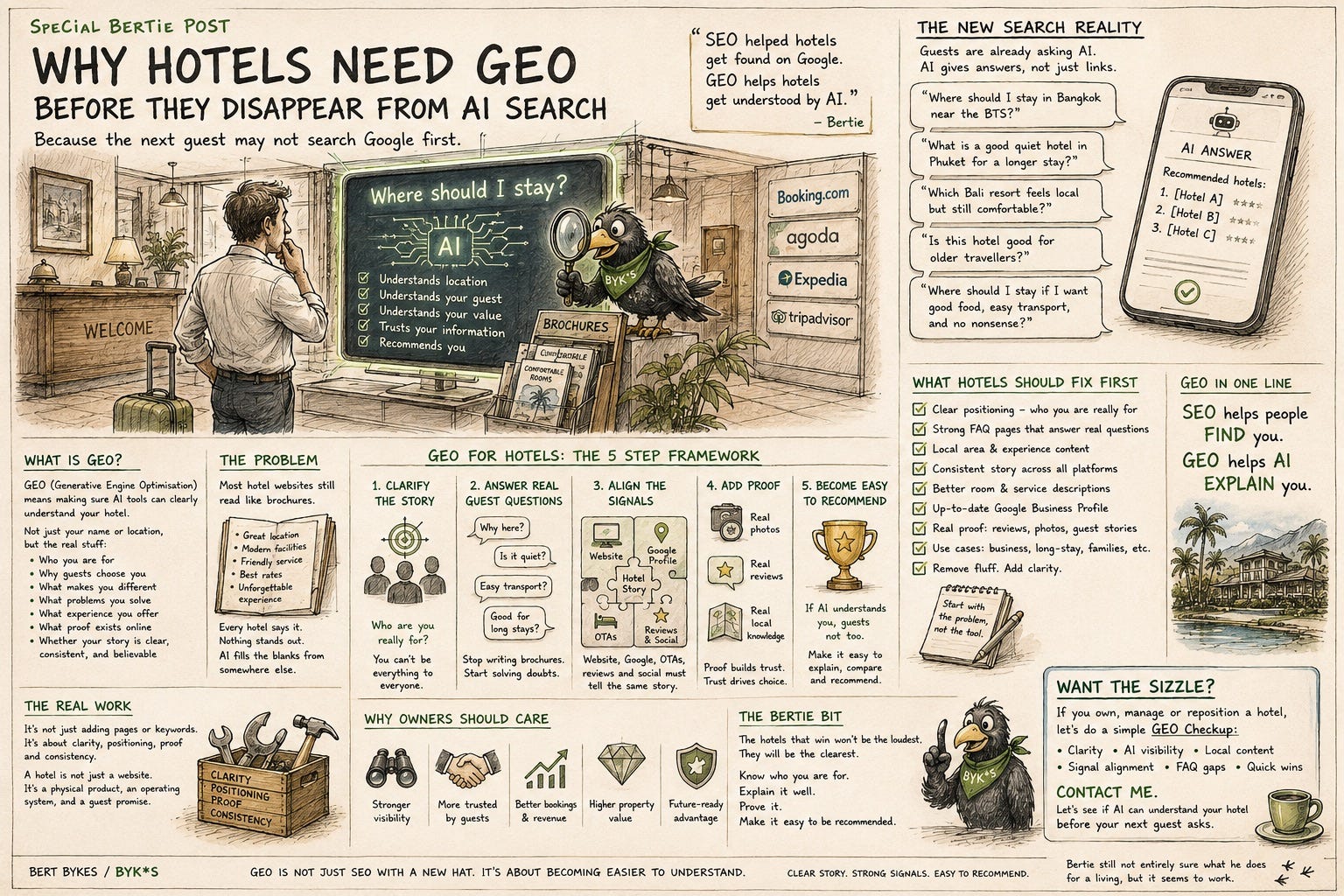
Image Credits: All visuals © Bert Bykes / BYK*S, unless otherwise noted.
🐦 Bertie — still not entirely sure what he does for a living, but it seems to work.
💬 Your turn:
If a guest asked AI to recommend your hotel, what would you want it to say?
Post your comments below. Let’s build a better blueprint together — one small action at a time.