
Landscape as Experience
The Resort Begins Outside the Room | Ch.19

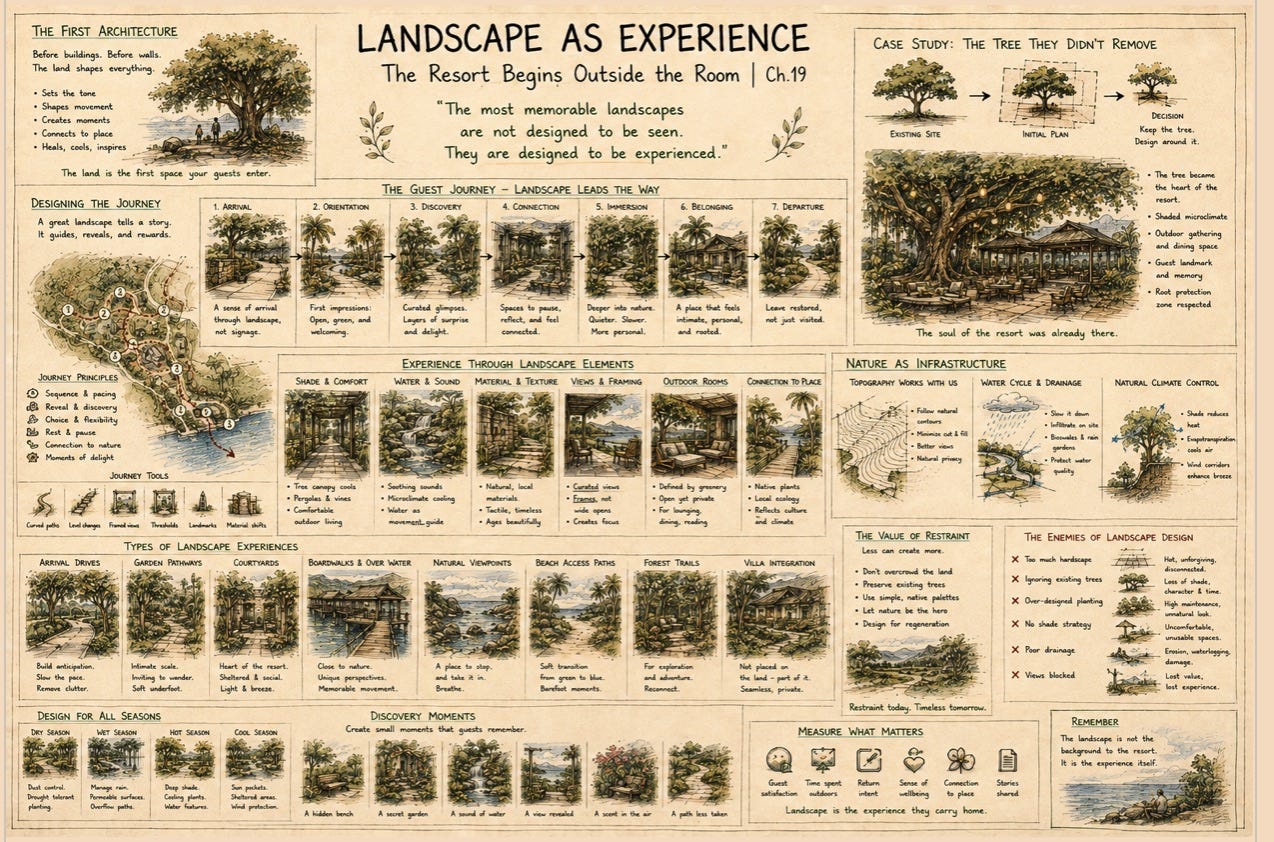
Many developers see landscape as decoration.
Something added after the buildings have been designed.
A layer of planting.
A few trees.
Some pathways.
Perhaps a water feature near the lobby.
The best resorts think differently.
They understand that landscape is not decoration.
It is experience.
Guests begin interacting with the landscape long before they enter a room.
The arrival road.
The first tree.
The sound of water.
The view through the lobby.
The pathway to breakfast.
The garden outside a villa.
These moments quietly shape how a place feels.
In many cases, guests spend more time experiencing the landscape than the architecture itself.
The First Architecture
Before buildings existed, there was landscape.
The land was already telling a story.
Topography.
Vegetation.
Water.
Wind.
Shade.
Views.
The strongest masterplans listen to these conditions rather than fighting them.
When development works with the site, the result often feels effortless.
When development works against the site, guests feel it immediately.
The land usually wins.
Designing the Journey
Guests rarely remember every building.
They remember journeys.
The walk to breakfast.
The path through the gardens.
The moment a view suddenly reveals itself.
The transition from public space to private retreat.
Landscape creates these transitions.
It controls rhythm.
Pace.
Discovery.
Anticipation.
The best resorts understand that movement is part of the guest experience.
Not simply a way to get from one place to another.
“Guests remember the walk almost as much as the destination.”
Nature as Infrastructure
Trees are not decorations.
Shade is infrastructure.
Water management is infrastructure.
Natural drainage is infrastructure.
Vegetation buffers are infrastructure.
Landscape often performs multiple functions simultaneously.
Reducing heat.
Managing stormwater.
Improving privacy.
Supporting biodiversity.
Creating beauty.
The most successful landscapes work hard while appearing effortless.
The Value of Restraint
Not every space needs to be designed.
Not every view needs to be framed.
Not every piece of land needs a feature.
Sometimes the most memorable landscape decision is leaving something alone.
An existing tree.
A rock formation.
A wetland.
A view corridor.
A piece of untouched forest.
Nature often provides stronger experiences than anything we can build.
